BEING REFUSED ENTRY INTO A BOUILLON RESTAURANT researched, only quickens my pace. On foot I’m hopping on to the next. A frog couldn’t catch me.
Crucially, prefacing this with what happens next: a traveller for good food finds it, right before they give up the search. Opening hours are all over the shop in Caen—specifically this one place refusing me entry—which is why it’s come to this hopping.
Hidden gems and how to find the best Bouillon
Bouillon restaurants are, mostly, a Parisian thing. Luckily, there’s more than one in Caen, Normandy. Tucking mobile maps into pocket beds for the night, proves revolutionary to restaurant seeking. No one stumbles, they look. Looking up at new surroundings is the point of escaping old ones. Listening to or staring at screens, is not. Find the flow of people gathering to connect at night. Likely, it’s where to be.

Whatever the weather, the streets at night in Caen are charmingly littered with lively locals, looking to gather for a drink, a crêpe, a bite to eat before cozy apartments, lining the same streets, greet them.
Experience led by proficiency: dining alone in Caen, Normandy
Steeped in historical significance, a French bouillon experience is to a travelling an eater, an exceptional opportunity to luxuriate in one’s eating wants, in comfortable affordability. Entering a spacious, welcoming restaurant, feeling encouragement in taking pleasure in good quality food, is a bit like home. Or a public house, when connected by community lucky Londoners find in their local.
Trying various dishes brings a sense to ease to the process of eliciting those that speak to personal tastes. Typically, Paris is the way to go, for the full effect of budgeting dining expenditures in the Capital.

French onion soup in france
Just as the French don’t do rushed dining, rushing into what constitutes for it: a relaxing, late dinner seems, also, inappropriate. As does detailing why a restaurant, that sounds like a stock cube; a bouillon, is as fun as it is French. Finding even itself filled to the point of requiring reservation, on a Saturday night.
Soup of the French onion variety seems terribly common. As if it were a National dish, like fish and chips. Something seen on every generic French bistro in London that panders to gastro pub menu enthusiasts favouring jammy scotch eggs made with black pudding, to say, a sausage roll. Yet in France it’s neither a National dish, nor is it fancy in any way. It’s yearned for when unwell, perhaps, or following celebrations where too many drinks are had. Is it any good though?


Generally, French onion soup isn’t attractive to order, considering all the other alternatives on offer as a starter at any good French restaurant. Bouillon Saint Martin in Caen challenges my persuasion. Points of note are that the portion size isn’t a bucketful. Affordability and inability to satiate, is the point of ordering starters (plural) at a Bouillon.
French onion soup — bouillon or broth?
Beefy, meaty soup, is what’s typically off-putting. Beef noodle soup without the butter and beef, encapsulated this dish equates in fact not beefy at all. One wonders about the stock used; nothing almost gravy like about it, nor do the onions resemble a caramelised mush. This is essence of onion, soft Roscoff slivers, dispersed Gruyrère goo and slightly fermented baked bread. Hint of bay and bright alcohol cooked off and not a garlic crouton in sight. None of it is sloppy or astringent, as my description may suggest. Perhaps it is their take on it; Bouillon Saint Martin style.
In the face of modernity, perceived assumptions of antiquation are of no threat to bouillon culture in France. Such establishments fill with friendly faces, families, all walks of life. It’s not different at Bouillon Saint Martin the heart of Caen, Normandy. French onion soup, eaten out of comfort or after drinking, late at night, makes sense as a menu option here.
“Venite ad me omnes qui stomacho laboratis, et ego vos restaurabo”
It’s no coincidence that the restorative properties of a bouillon broth led to Monsieur Boulanger’s shopfront engraving of “Come to me, those whose stomachs ache, and I will restore you,” in Latin. Nor surprising is that it closed around 1854 when the street was torn down.
Having tried it in brasseries across London all it needed there, for me, was a splash of red reduction and it could go onto a banger or Sunday roast – spare the cheese. At Bouillon Saint Martin in Caen, this is not that. When I stir my spoon into it the creamy emulsification resembles my Pastis the moment the ice hits the glass and the water is release through it. You want to take your time with this, trust me.

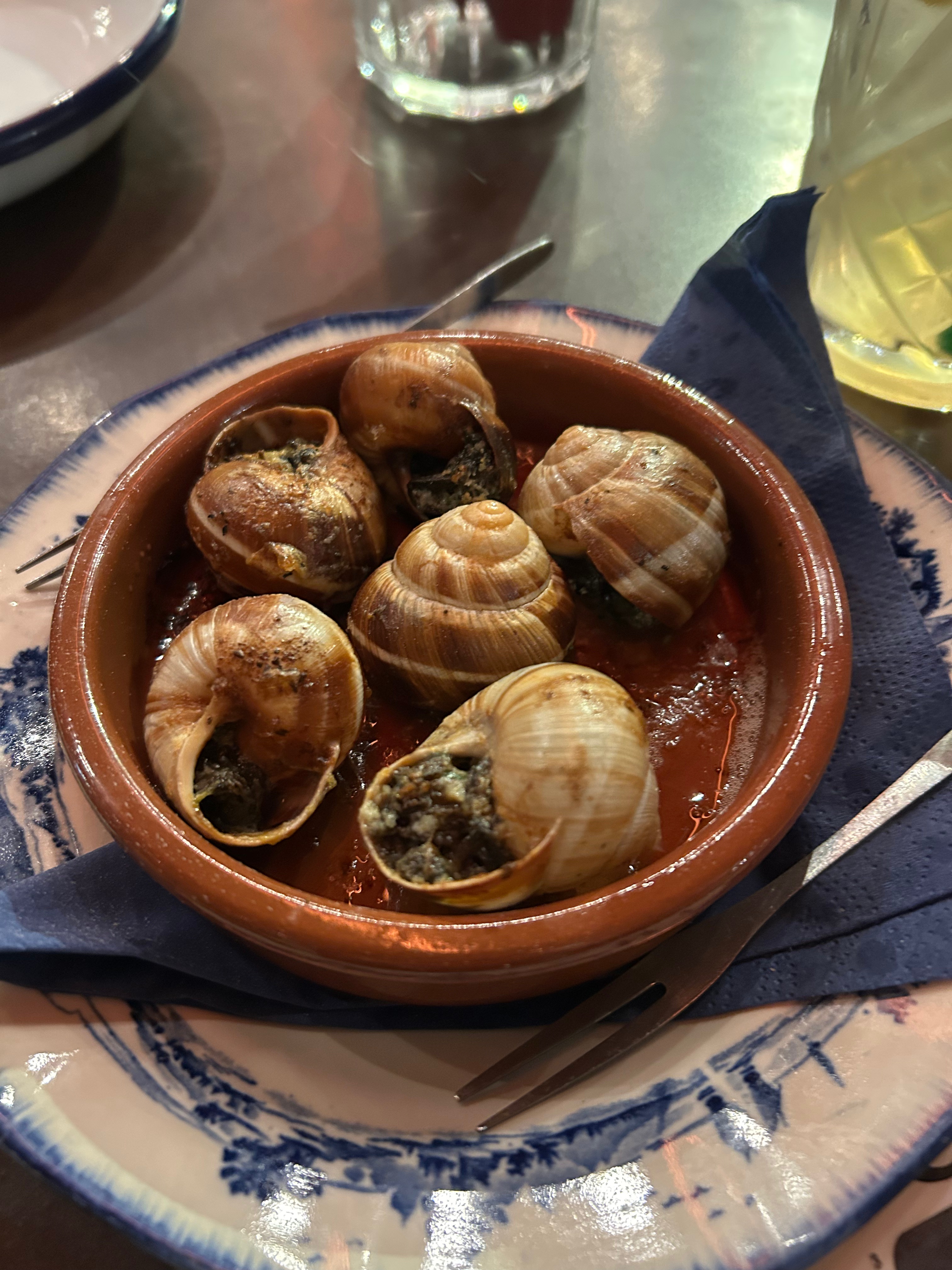
Escargots de Bourgogne ingredients
Butter, parsley, garlic and the Helixpomatia. Burgundy snails: most prized and a protected species in France. Also known as the Roman snail they are a classic to be eaten in this preparation. The three other varieties are the “escargot du turc”, “petis gris” and the large grey snail.
While restaurants in France typically use fresh precooked snails (before adding the butter etc), home cooks or kitchens without such availability used canned. These are then stuffed back into a snail shell purchased separately for this purpose.
How to cook French escargots de Bourgogne
Garlic isn’t playing here. Lingering lightly, as its cooked through yet generous enough to still linger. Ensuring that maximum snail meat tenderness is down to the cooking technique. Overheating will render the snail tough to chew. Assisting snail meat tenderising reminds me of Chinese meat velveting techniques.
Popular use of poaching in French structured recipes dates back to the evolution of foundational sauces in 1651. In the case of escargots de Bourgogne, this can be done to also enhance flavour absorption of the sauce. Before baking, gently poaching Burgundy snails in Burgundy Chardonnay; any dry white wine, or a light broth assists meat tenderisation.
Tasting earthy notes of the mollusc’s diet with each bite bathed in Beurre d’Isigny is divine. A sip of some wine ties each snail present up, turning its devourment by me into a real eating experience. The accompanying complimentary bread acts as a delivery mechanism for every morsel of that butter bath gushing from the shell with each extraction of flesh.

Caen France - Bouillon Saint Martin
The snappy smoked pork sausage is satisfying to cut through with the steak knife the dish is presented with. The jus is light and seeps into the chive scattered mash. The portion of the accompanying carrots and mushrooms can be less or replaced with a few simple roast carrots or plain cabbage. Although a speck or two of Dijon would not go a miss here, I add nothing to any dish, if not prompted.
Inexpensive French faire served honestly in an expensive environment: the French bouillon re-opened in the late 1850s. This time it was butcher Pierre-Louis Duval serving cheap meat and broth to workers in Paris. By 1900, Paris had nearly 250 bouillons.

Once sat, it’s rare to see a new set of diners appear. Most of our closely placed tables seat a family, a couple. It makes as good case for this Michelin thing where they excel: “Take a seat. Get comfy. It’s going to be a long ride.”
I’m not a dessert person. Fresh choux pastry, warm, I might add, enveloping vanilla bean ice cream like a hug only an airy pastry puff could give. Créme patisserie with vanilla bean and chunks of dark chocolate. I’m still dreaming about it. Hot and cold, crunches of bitter chocolate, all afloat colossal cream clouds swimming in Willy Wonka’s pool.

Closing thoughts on Bouillon dining
assumingly antiquated worth Once seated, no one at the restaurant will rush to take your order. You are in France eating out. This activity is a pleasurable pass time of pleasure, a celebration of gastronomical tradition, steeped in history. It’s nothing to do with their service charge / no tipping culture.
Now, I know what you’re thinking. This isn’t proper French dining – it’s a Bouillon restaurant. They originated in Paris, more specifically with the first one opening in 1767 on Roue des Poulies and named after Monsieur Boulanger, commonly referred to as the 1765 Parisian soup vendor.
Bouillon Saint Martin address – 21 Pl. Saint-Martin, 14000 Caen, France.
Date of Visit - October 2025
Food 8.9/10
Value for Money 10/10 (25-30 Euros pp for 1-2 appetisers, main course, desert with a carafe of wine, digestif)
Mood/Vibes 10/10
Leave a Reply