MY LOVE OF DIM SUM transports me to where it started. Not just my love of dim sum. Chinese food devoid of beef with broccoli. Specifically, Chinese Cantonese food in London. Cantonese classics designed for whatever time of day you fancy: yum cha.
Giles Coren once said “I love Chinese food above all things”. You know, as he does. Before going on to say: “Indeed, if I lived in China, I would never leave. Even if I was allowed to.”
Date of visit 15 January 2026.


Off to Gerrard street I go, or rather just off it. Joy King Lau on Leicester Street, in the District of Soho, London. Man is it buzzing before The Lunar Year. Take it from me, or a random queuing in front of me. They’re repeating this information into their phone as if it’s unheard of. Three unimpressed teenagers beside the news broadcaster look down at their rain-soaked trainers.
Joy King Lau is about 12 steps in front of a bustling See Woo. Prices went up in See Woo: it’s only fitting I overhear West London mummies chide their children there. Done, naturally, Waitrose tones that pretend to whisper. At See Woo such mummies emphasise to all of China Town that packet noodles are full of sodium. Which is bad.
MSG is hidden in the noodles. Stay well clear. A cautionary tale that keeps their boarding school bound children curious around kitchen kettles in dormitories and away from golden arches. Then further away and more intrigued, by extension of taking lengthy gap years.

What does MSG taste like?
Mono Sodium Glutamate Umami flavour hits a dish with deep savoury notes. Like parmesan cheese, sprinkled atop a pasta or caesar salad. Enhancing inherent flavours of the dish its sprinkles are interspersed with, it encourages them to rely less on salt.
Think nutty roquefort; walnut bitterness, both foods naturally high in glutamate. Naturally occurring glutamate in tomatoes offer a milder taste comparison to MSG seasoning’s capacity for flavour enhancement. That glutamate naturally occurs in foods we consume regularly in the West, while palates treat themselves to addicting snacks and condiments laced with MSG, speaks volumes.
Any way, Chinese New Year is upon us: See Woo tills are rolling up those paper receipts as fast as Germans scan foodstuffs at Lidl daily. Time to eat some Cantonese classics in China Town.
Dim Sum Review of Har Gow at Joy King Lau – Chinatown London
Mention of dumplings comes from a loving place. Fascinatingly drawn to them; architecturally, texturally, their tea adjacent appetite inducing aesthetics, they’re as reassuring as a hug.
Har Gow at Joy King Lau doesn’t entice at first glance: fewer dumpling folds means visibility to prawn filling. Aromas are there, as well as the steam we want to see.


The façade is real. King prawn dumplings throw me off. There’s an adhesive slick of prawn mayo flavouring. It’s as though the filling were a pink striped fish ball disguised in the shape of a prawn – a bit odd . The bite of whole or chopped prawn is there: they’re not even chopped up, in fact, which is the style sometimes. Perhaps the thicker wrapper with fewer pleats lends itself to the gummy texture overriding the dumpling chew. It offers an eating experience with underlying pure prawn query.
First to arrive was another dish, however. There’s a gap of around 20mins or so between when I receive it and all the other four orders I place.
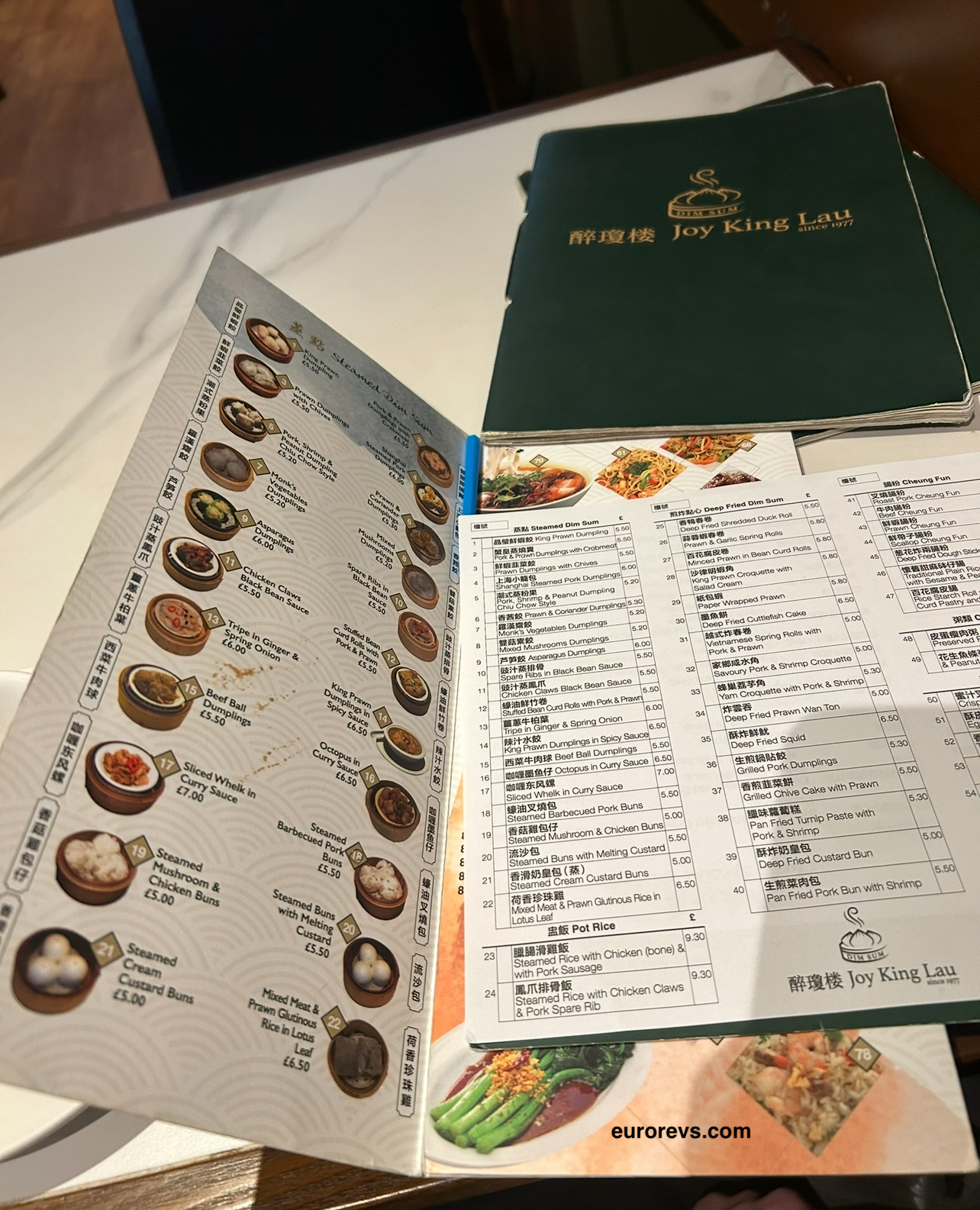
Dim Sum Menu at Joy King Lau


Amusement kicks in picking up the pen to apply it to the paper dim sum ordering menu. Participation, is the sense it gives me. As diners are we taking part in an exam, unbeknownst to us? Will our servers determine the doctorate holders in this particular China Town establishment? Who demonstrates sagacity in the discernibly noble, yet humble, practice of picking dim sum to yum cha?

Neutrality across their faces as they collect papers to pass to the kitchen summons a tremendous jealousy in some. Without rhyme or reason everyone is envious of everyone else’s orders. There’s no tell-tell sign by servers – trying not to laugh, for example – so we double check we can order more. Just in case, you know. As if that puts power to pencil and paper, rather than kitchen. Steamed in basket or plated cold, a feast is upon us.
Phoenix Claws in China Town London – Dim Sum review
Phoenix claws or chicken feet in black bean sauce arrive with all of my multiple-choices. All at once. Each claw in split into half for ease of eating, as is expected. They’re have a similar flavour – as well as that bite to the bone mechanism of consumption – to the chicken wing. Texturally, they are more comparable to a braised pig trotter. The chicken feet envelope the sweet, savoury umami notes that the (most likely jarred) black bean sauce brings to the dish. These were good, very good indeed. A generous portion too, at £5.50.


How to Eat Chicken feet
As you would with a wing, get messy. With your clean hands suck, savour, spit the little bones out. They’re a textural sensation full of fatty unctuousness, that pairs well with a beer. A smacked cucumber salad with chilli also does the job. It’s not considered rude to handle, or rather tackle the chicken feet this way. Apart from it being practical to pick them up, there’s the sensory satisfaction.
Pop a peppery slice of fresh green chilli into your mouth. Get some of the black vinegar into the mix too. Follow it up with crunchy, cooling cucumber. It’s a winning combination that sees you delve right through your bamboo basket of chicken feet.
Cheung Fun in China Town London Review
Cheung fun or rice rolls, as they known across the pond, are a typical street food, as well as being a staple dim sum menu item in Hong Kong. Also commonly eaten in South China – specifically in the Guangdong providence of China – the delightfully slippery thin batter of rice and starch flour is steamed to remain silky, thin and malleable.
When eaten alone, toothpick-like stick to hand, as a street food, peanut (and hoisin); peanut and sesame or spicy sauce accompany them. At dim sum they’re either topped with a slightly sweet soy sauce dressing, or it’s off to the side for dipping.
Also as a dim sum it can be filled with shrimp; Monk’s vegetables, beef, pork or a savoury Chinese donut, called a youtiao. You tiao being a deep fried stick of dough that can be purchased from most bakeries in Chinatown, London. Other methods of consumption vary from dipping it in congee, as it soaks up liquid, while maintaining bite. A similar version accompanies Vietnamese Pho. Savouring it fresh soy milk for breakfast as Brits might dunk a digestive into hot, milky tea, is another – of many – ways to enjoy a Chinese doughnut.


Crunchy in the middle, steaming hot, thin elastic batter with a gorgeous light aroma of spring onion. This is the best dough stick cheung fun I have ever had. The subtle symphony of sweet and salty reminded me why silence speaks louder than words.
Steamed Buns with Melting Custard
Steamed buns here were as stale and stodgy as they were pale. There was no custard – in fact it was more of a half crystallised salted egg yolk situation – which I love. However, eating it out of a thirst inducing dry bun; an excuse for a misnomered steamed bun, was unpleasant. On a quieter day the buns might be fresh; bouncy and oozing with salted egg custard. As they should be.


Why don’t more people order this at dim sum?
Monk’s vegetables dumpling at £5.20 (excluding service charge) cheapens this Cantonese dim sum stunner of an order. Jam packed with rehydrated wood ear mushroom, lotus and other root vegetables. Delectable with preferred ratios of dumpling dipping sauce.


Joy King Lau China Town London Review
Here’s my overall review, based on two visits to Joy King Lao. Return for my favourites I will. Soft shell crab is one to try next time too. For dim sum, in this tourist-friendly zone of London, theatre goers throng, food entices at every corner – this is decent. Read decent as tasty.
Food – 6.8/10
Value for money 8.5/10
Vibes 7.5/10
Service – 6/10
Leave a Reply